
Movement #1 - a few minutes can make a big difference
Posted on January 11 2026,
For years, the UK Physical Activity Guidelines have focused on how much time we spend exercising. However, emerging research suggests that how hard we move may matter just as much (if not more), for long-term health and longevity.
Why meaningful Vigorous Physical Activity (VPA) matters
-
Cardiorespiratory fitness (VO₂ max) - stronger heart and lungs to support long-term health.
-
Blood vessel health (endothelial function) - keeps circulation flexible and efficient.
-
Metabolic control (glucose & insulin sensitivity) - helps manage blood sugar and energy.
-
Cellular energy (mitochondrial efficiency) & resilience (hormesis) - cells produce energy better and brief stress strengthens recovery.
This article reframes exercise advice away from counting minutes and towards recognising the value of higher intensity exercise in forms that are adaptable, inclusive and realistic.
Point 1: The current guidelines
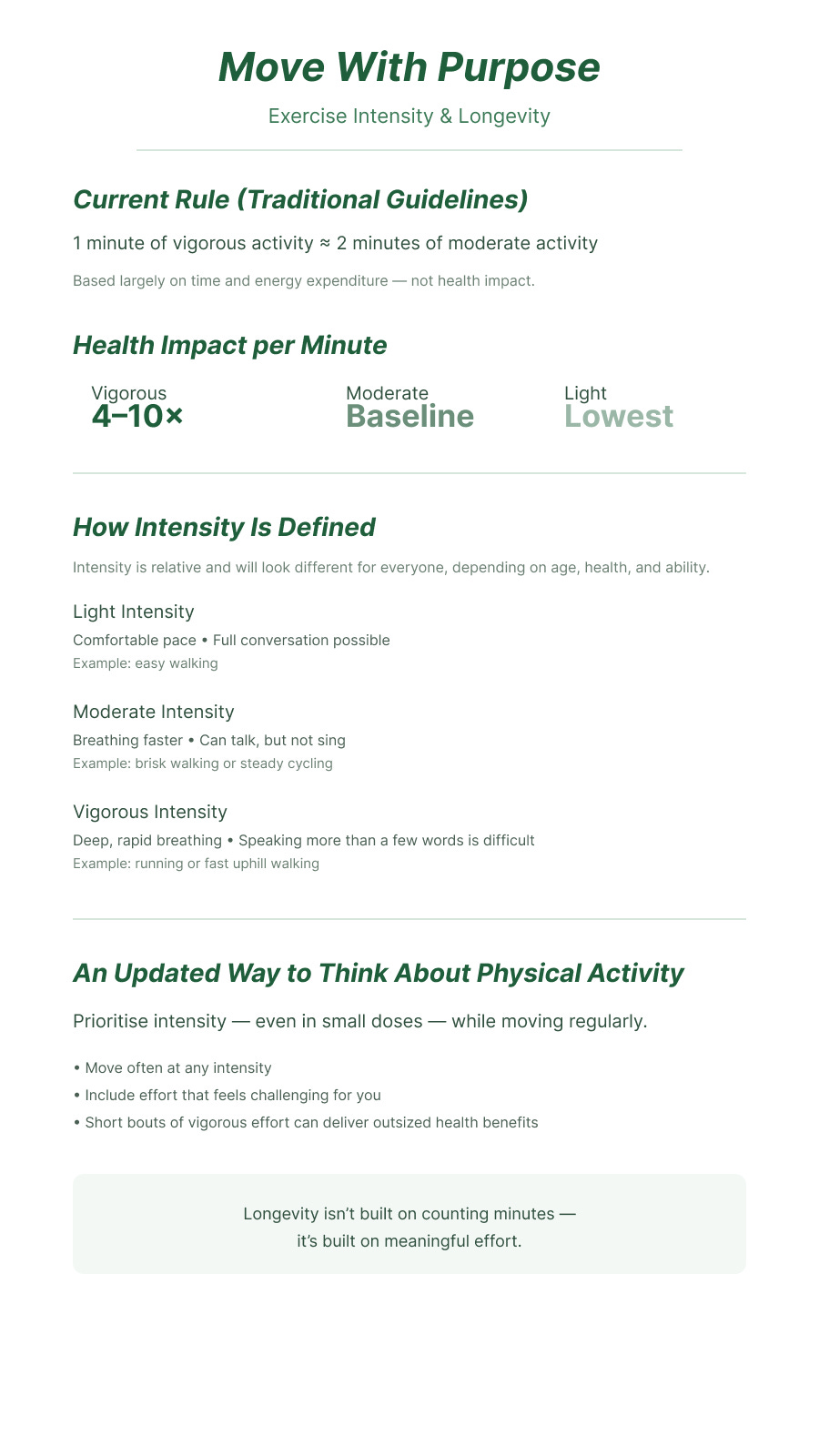
Physical activity has traditionally been quantified in public health advice: minutes per week, with vigorous activity “counting” roughly double moderate activity. This framework is simple and practical, but it treats all minutes largely the same and doesn’t fully reflect differences in physiological impact.
Point 2: Health impact per minute
Not all movement produces the same biological response. Research suggests that vigorous activity delivers disproportionately larger benefits per minute compared with moderate or light movement (particularly for cardiovascular fitness and longevity). This doesn’t mean moderate or light activity isn’t valuable, but it helps explain why shorter and harder efforts can be so effective.
It appears that VPA is far more “time efficient” than moderate or light activity.
For the same level of risk reduction (5–35%), one minute of VPA was equivalent to:
~4.1 minutes of moderate physical activity (MPA) for lowering all‑cause mortality risk
~7.8 minutes of MPA for lowering cardiovascular mortality risk
~5.4 minutes of MPA for reducing major adverse cardiovascular events
~9.4 minutes of MPA for lowering type 2 diabetes risk
~3.5 minutes of MPA for lowering cancer mortality risk
Point 3: How intensity is defined
Intensity isn’t about specific exercises — it’s about how hard the effort feels to you. We generally define physical activity as light, moderate and vigorous using breathing and conversation cues rather than rigid rules (see more details below). Importantly, intensity is relative: the same activity may fall into different categories for different people depending on age, health, fitness or functional ability.
Point 4: An updated way to think about physical activity
Instead of focusing only on total minutes, I would like to proposes a more flexible approach: move regularly and whenever possible, and include brief moments that feel challenging and vigorous for your body. These don’t need to be long or extreme to be meaningful.
Point 5: Reflection
Rather than chasing rigid time targets with exercise, consider how you can add moments of meaningful physical activity effort into your own life …in ways that feel challenging but achievable for you.
Always consult your doctor or health professional before starting a new or more intense exercise routine if you have health concerns or long-standing conditions.
References
-
Zhao M, Veeranki SP, Magnussen CG, Xi B. Association of physical activity intensity with mortality: a national cohort study. JAMA Intern Med. 2024;184(6):678–687. Link
-
Zhang X, Chen Y, Wang L, et al. Wearable device–based health equivalence of different physical activity intensities: a cohort study. Nat Commun. 2025;16:4572. Link
-
Sorrentino V, Martucci M, D’Amico M, et al. The effects of exercise training on mitochondrial function in cardiovascular diseases: a systematic review. Int J Mol Sci. 2023;23(20):12559. Link
0 comments